Founder of the month: OnSite Solutions
23.09.2026
Farzad Yaqubi
Founder of the month
How can real estate be made more efficient, transparent, and sustainable? This is precisely the question OnSite Solutions is addressing. The Karlsruhe-based startup, which has ties to the Karlsruhe Institute of Technology (KIT), is developing BAIOSS, a platform that maps the digital maturity of buildings and identifies specific opportunities for optimization.
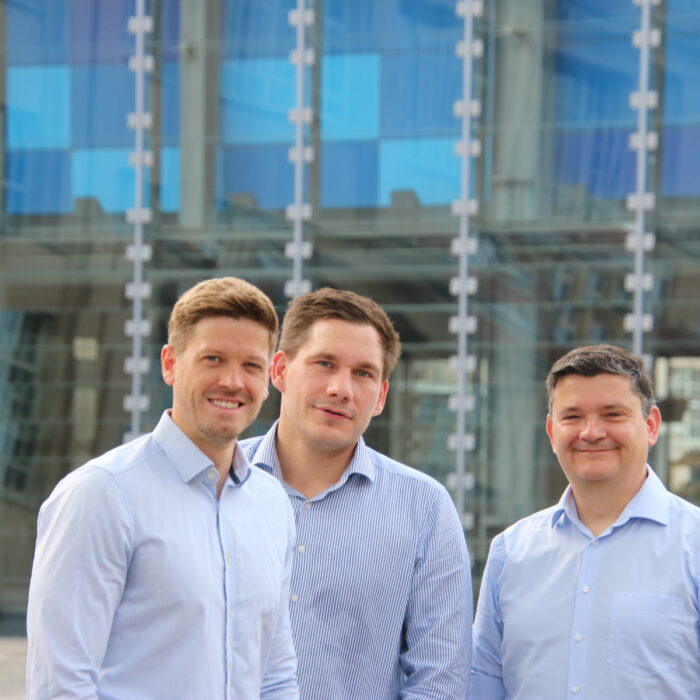
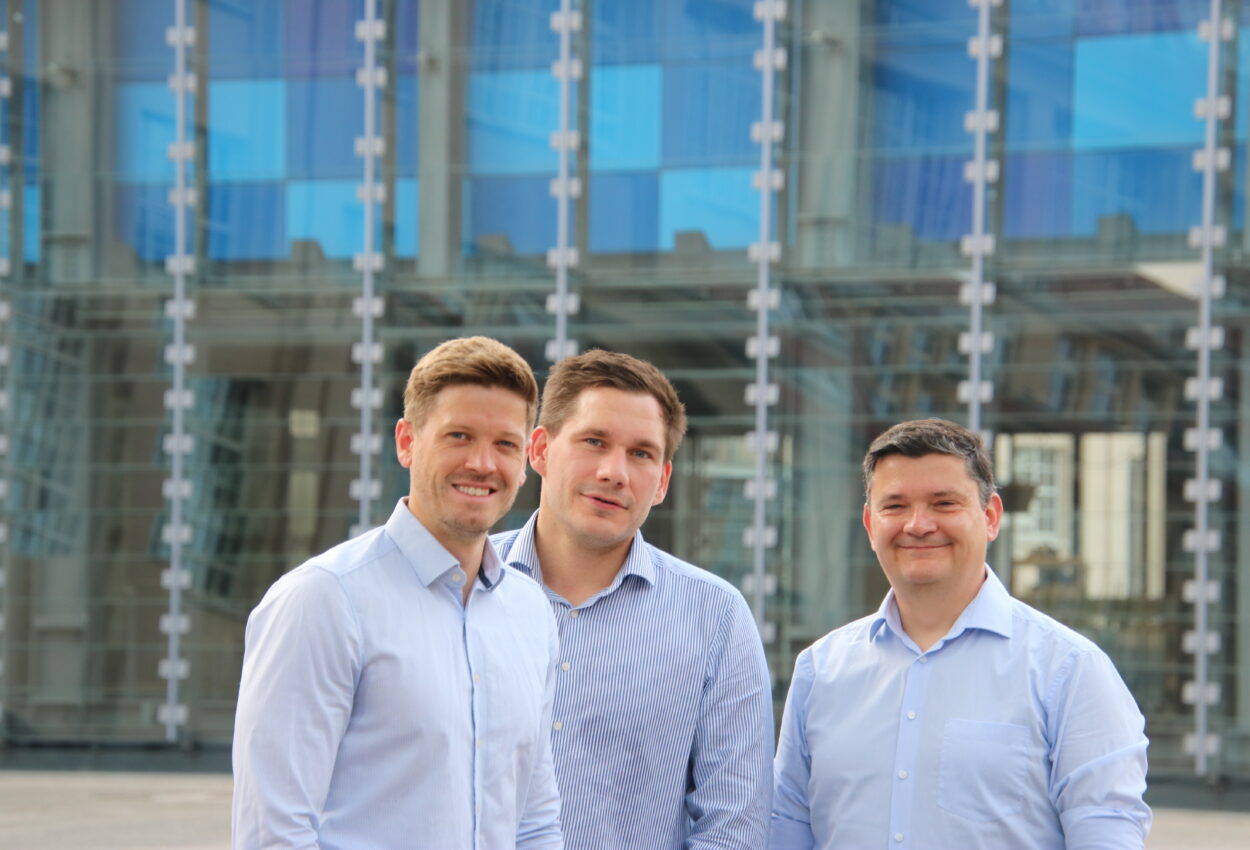
OnSite Solutions was founded by Dr. Tristan Emich, Dr. Tobias Kropp, and Mario Dropulić. With their solution, the team helps building owners, operators, and planners make better use of existing data and technical systems and make building operations more sustainable.
In a conversation with host Daniela, Tobias Kropp shares insights into his journey from research at KIT to entrepreneurship. They also discuss the role AI can play in the building operations of the future and why early customer conversations are often more valuable than the perfect technical solution.
You can find the full interview on Spotify and Apple Podcasts.

What does your company stand for?
OnSite Solutions is dedicated to the digital transformation of building operations. With BAIOSS, we are developing a platform that helps building owners, operators, and planners understand a building’s level of digital maturity and use that insight to identify specific actions.
Our goal is to make existing data and technical systems usable in a way that allows buildings to be operated more efficiently, transparently, and sustainably.
Where and how did you come up with the brilliant idea to start the company?
The idea emerged from our collaborative work at KIT. We delved deeply into the digitization of buildings and, in particular, the Smart Readiness Indicator. In the process, we realized that while there are an increasing number of requirements and possibilities, in practice there is often a disconnect between assessment, technical data, and concrete measures. We wanted to bridge precisely this gap. The research question eventually led to the idea of developing a practical digital product based on it.
How did the founding team come together?
We (Tobias and Tristan) already knew each other from our time together at KIT. That’s where the original idea for our company was born, and it continued to take shape as we worked together on the digitization of buildings. Mario joined us later, more by chance, as part of our immediate circle of friends. As we talked, it quickly became clear that our different skill sets complemented each other very well. Our shared vision and personal connection ultimately gave rise to our current founding team.
What is your grand vision?
Our vision is that, in the future, buildings will be able to independently identify areas for improvement and use that information to implement concrete improvements. Today, there is often a disconnect between the vast amounts of data, the technical systems, and the people who operate a building. We want to bridge that gap. In the long term, BAIOSS will not only assess a building’s condition but, as an intelligent platform, will orchestrate various data sources and AI agents, thereby enabling increasingly autonomous building operations.
Where do you see significant hurdles in the startup process?
One of the biggest challenges is consistently making the transition from research to business. In academia, the focus is heavily on conducting in-depth research into a specific question. As a company, on the other hand, you have to figure out very quickly what specific problem customers actually want to solve and what they’re willing to spend money on.
Where did you go for support?
In the early stages, we received support in particular from the KIT-Gründerschmiede and the CyberLab in Karlsruhe. Both helped us refine our idea, gain our first entrepreneurial experiences, and receive valuable feedback. Later, AXEL, the energy accelerator, and GroundBreakers became additional key resources. We found the exchange with mentors, industry experts, and other founders to be particularly valuable, as they helped us develop a marketable product from a science-based idea.
What were some of the biggest challenges you faced during your startup phase?
A major challenge for us was to take a complex technical topic and turn it into a product that is easy for users to understand and use right away. Building digitization, in particular, involves a great many technical details, standards, and different systems. Our task was to handle this complexity behind the scenes without burdening the user with it.
First pilot customer, first prototype—what did you learn from the experience?
The initial conditions vary greatly, especially when it comes to buildings. Data quality, technical infrastructure, and existing systems differ significantly from building to building. Therefore, a solution must be flexible enough to handle a variety of initial conditions. These insights have been directly incorporated into the further development of BAIOSS.
What has changed since the organization was formally established?
With the company’s official incorporation, a scientific idea became a real business with real customers, expectations, and responsibilities. Suddenly, it’s no longer just about whether something works technically, but also about whether it’s understandable, whether there’s a market for it, and whether a sustainable business model can emerge from it.
How did you solve the funding problem?
We are currently still receiving funding through the EXIST Startup Grant. This has enabled us to advance the development of BAIOSS and build the company during the startup phase so far. What happens next will become clear in the coming months. We are currently laying the groundwork for the next phase and exploring various financing options.
Are current global crises affecting your startup?
Since we are a software company, we are not part of traditional manufacturing or supply chains. As a result, there is hardly any direct impact on our production. Indirectly, however, we are noticing that economic uncertainty is influencing investment decisions.
What are your next major milestones for the coming 12 months?
Our most important milestone, for now, is to further establish BAIOSS in the market and to develop long-term customer relationships based on our initial discussions and projects. At the same time, we want to continue expanding the platform’s functionality and, in particular, further develop the areas of action recommendations, cost-benefit analysis, and AI agents.
In your opinion, what qualities should a founder have?
From our perspective, what you need most of all is perseverance and a willingness to keep learning. As a founder, things rarely go exactly as you originally planned. You therefore have to be willing to constantly question your own idea while staying true to your long-term vision. It also helps immensely if you’re not afraid to tackle things yourself, even if they fall outside your existing area of expertise.
Do you have any practical tips for other young entrepreneurs?
Talk to potential customers as early as possible. Don’t wait until the product is finished; start during the ideation phase. We’ve learned a great deal from testing our assumptions against real-world experience right from the start.
Looking back now, what might you do differently?
We would probably reach out to potential customers even earlier and more consistently. Coming from a research background, there’s a risk of focusing too heavily on the technical solution at first. Today, we would test even earlier to determine which feature actually creates the most value for the user.