Founder of the month: RAZO Energy
13.03.2026
Emma Schmitt
Founder of the month
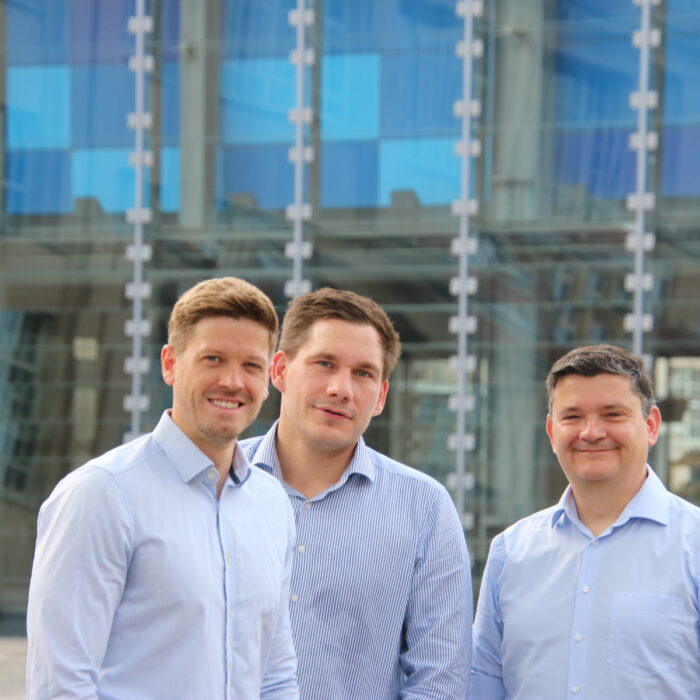
Make good tech for a cleaner earth. Based on this principle, Willy, Max, and Kai are developing their startup RAZO Energy.
At RAZO Energy, we take a thoroughly pragmatic approach to actively advancing the energy transition. We firmly believe that we need real solutions and simply have to start implementing them, rather than just exploring all the possibilities in theory behind closed doors.
Internally, we value our inner “mad scientist” – our best and most innovative products are the result of what we call “deep focus work.” At the same time, we place enormous value on openness and honesty in our communication. In order to successfully translate the highly complex new requirements of the energy industry into functioning technology, we need one thing above all else: a tremendous willingness to learn.
You can find the entire conversation with host Daniela on Spotify and Apple Podcasts.

Where and how did you come up with the brilliant idea to start the company?
The actual spark came during a trip to Praia de Razo in northern Spain (Galicia)—hence our name. We asked ourselves: Why not use the countless small batteries in electric cars to drive forward the energy transition? Cars are unused for an average of 23 out of 24 hours, and daily journeys are usually less than 100 kilometers. This means that the battery storage capacity of an electric car remains largely unused. With currently around 50 million cars in Germany alone and 250 million in Europe (all of which will eventually be electric), there is huge untapped potential here for storing renewable energy, stabilizing the power grid, and reducing immense grid expansion costs. In practice and in discussions with end customers, however, we quickly realized that there are still many fundamental hurdles to local optimization. Our conclusion: Before secondary use cases for assets such as electric cars (e.g., grid serviceability) can be addressed, the primary use case must first function smoothly. Specifically, this means that the electric car is intelligently charged with surplus PV, dynamic electricity tariffs and home storage are taken into account – and all of this is completely automated, without the user having to intervene on a daily basis.
How did the founding team come together?
Willy and Max had the original idea and together laid an important foundation for RAZO Energy. When it became clear that we needed more tech support, we got in touch with Kai. He was immediately enthusiastic about the project – even though he was traveling through Southeast Asia at the time.
The full implementation of the idea then began thanks to EXIST start-up funding, with Prof. Hagenmeyer providing us with active support as a mentor. Once the EXIST funding period had expired, it was time to found the GmbH.
What is your grand vision?
Our “why” is clearly formulated: Make good tech for a cleaner earth. We want to solve real, pressing problems in the world with intelligent software.
The “how” looks like this: We harness the flexibility of end devices such as electric cars, heat pumps, and battery storage systems to make better and more efficient use of renewable energies. The aim is to adapt our flexible electricity consumption to the often inflexible generation (sun, wind). Our vision is to drastically reduce the immense grid expansion costs required for the transition from the fossil fuel era to a green energy world—by intelligently utilizing existing devices for multiple purposes.
Where do you see significant challenges in the start-up process?
The biggest hurdles for us were definitely bureaucratic in nature. Unfortunately, Germany is not particularly start-up-friendly in this regard. We didn’t want to do anything totally crazy, we just wanted to follow the principle of “start small and then grow bigger.” Specifically, this meant that we needed a company structure that would allow us to grow healthily.
We wanted to convert our previous GbR (civil law partnership) into a GmbH (limited liability company) in a tax-efficient manner and hold the shares through a holding company rather than privately. In doing so, we realized that these legal forms do not mesh well at all. You can’t just start a new company because the tax office immediately considers it a hidden contribution if you have already generated some income. As a founder, you actually want to work on an innovative product and not spend all your time dealing with a huge bureaucratic overhead.
It was extremely difficult to find a consultant who was really familiar with this specific start-up issue – we must have made 30 phone calls before we found someone with the necessary capacity and expertise. The waiting times until we could formally go “live” were correspondingly long. Due to the complex notarial conversion and the holding structure, it took us more than four months.
Where did you get support?
We initially relied heavily on the regional network, in particular the KIT Gründerschmiede and the CyberForum. University contacts in Karlsruhe and participation in an accelerator (Climate Founders) were also very valuable to us. The exchange with mentors—people who have already built a startup from scratch themselves—was particularly important to us. We consciously try to learn not only from their successes, but above all from the challenges and mistakes that others before us have already mastered.

What were some of the biggest challenges you faced during the start-up phase?
One major challenge was finding a compatible way of working and communicating, especially since we do a lot of remote work. You have to learn to take matters into your own hands, even if you don’t know how to do something yet.
One of our most important lessons was: “Just because you have a good product doesn’t mean people will snap it up.” Since we are a very tech-heavy team, we first had to get used to doing a lot more sales ourselves and daring to go out there and be aggressive in our marketing.
Has anything changed for you since the formal launch? And if so, what?
Above all, there is now significantly more accounting and bureaucracy – “yeah”! Annual financial statements, legal requirements, balance sheets, and endless documentation are now part of everyday life. But joking aside, the formal founding was the right entrepreneurial starting signal. Knowing that everything is settled gives us security. It was also the perfect opportunity to clarify the distribution of roles internally. Externally, our visibility and perception have improved significantly. In addition, eligibility for many exciting programs is often linked to the establishment of a corporation.
How did you solve the financing problem?
We started out in the traditional way with bootstrapping and landed our first orders. In addition, funding projects and research programs are useful for driving our product development forward. Investor funds are only something we will consider in the future.
Do global crises such as the war in Ukraine have an impact on your startup?
We have indeed felt the effects of the crises, but in our sector they have tended to act as an accelerator. The extreme rise in electricity prices as a result of the war in Ukraine has led to a huge increase in the desire for energy independence. Many more solar systems have been purchased and interest in dynamic electricity tariffs – and thus also in our optimization software solution – has risen sharply.
What are your next big milestones in the coming 12 months?
We plan to tackle projects outside our previous Energy Management System Bubble (EMS). These include, for example, procurement optimization and a VPP (Virtual Power Plant) research project in collaboration with energy suppliers and municipal utilities. At the same time, scaling our own server infrastructure and further exciting feature improvements for our EMS construction kit are at the top of our agenda.
In your opinion, what qualities should a founder have?
- Being comfortable in being uncomfortable: You have to be willing to constantly venture into completely unknown territory and learn not to feel uncomfortable doing so.
- “You build it, you own it”: Especially in the beginning—and particularly if you’re more introverted or a pure techie—you have to push yourself and convince yourself. You have to go out, present your solution, talk to people, and actively gather feedback. Building the wrong product is known to be a very expensive startup mistake.
- “Be a flexible stubborn person”: You need a certain amount of stubborn conviction to believe in your own idea. At the same time, however, you have to be flexible enough to change course immediately if your assumptions turn out to be wrong.
Do you have any practical tips for other young entrepreneurs?
Continue to lead a normal life! There’s no point in working yourself to the bone. Nurture your friendships, take time off, and look after your health.
And don’t let your head hang down, even when it rains or hails in everyday startup life.