Founder of the month: marton.ai
27.04.2026
Aline Kinzie
Founder of the month
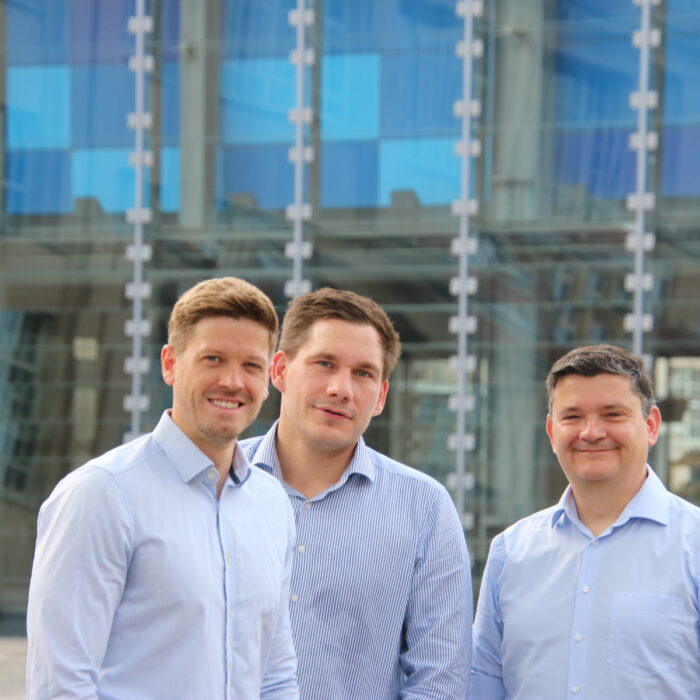
Many real estate listings still rely on static photos – even though videos are increasingly becoming the norm in marketing. This is exactly where marton.ai comes in. The startup founded by Antonia Dieterich, Mario Quint, and Marcel Doll – all affiliated with the Karlsruhe Institute of Technology – is developing AI-based software that automatically turns traditional real estate photos into professional videos. The team’s goal is to make high-quality real estate videos accessible to real estate agents and developers without requiring additional effort or specialized technology.
marton.ai embodies the vision: “Unlocking the power of professional real estate videos for all.” Our goal is to replace traditional, expensive, and time-consuming real estate videos with automation and AI. We enable real estate agents to create professional real estate videos from standard property photos in under 10 minutes, with no prior experience required.
In conversation with host Daniela, founders Antonia and Mario explain how they are revolutionizing the real estate industry together with co-founder Marcel. They share how they were able to reduce the cost of real estate videos by 90% through the use of AI, and discuss how important choosing the right partners is for a startup’s success and how they managed to acquire over 250 real estate agents as customers within just a few months. You can find the full interview on Spotify and Apple Podcasts.
Where and how did you come up with the idea to start the company?
We were already active in the field of 360-degree virtual tours, but we faced a major problem: Creating them was very time-consuming for real estate agents or service providers, since special 360-degree photos had to be taken with specialized cameras. We therefore sought a solution that would require absolutely no extra effort on the part of the real estate agent and instead work with the materials that are already available for every marketing campaign: classic real estate photos. Since we have always followed developments in the field of artificial intelligence with great interest, our decision was clear: as soon as the technology is ready, we want to be the first to generate professional AI real estate videos using only these existing photos.
How did the founding team come together?
Mario and Marcel had already met and worked together at a previous startup. When the decision was made to build marton.ai not as a pure agency but to develop intuitive software that allows real estate agents to create their own videos, Antonia was brought on board as CTO. This completed the trio: Marcel for strategy and business development, Mario for sales and creative direction, and Antonia for software development and machine learning.
What is your big vision?
Our big vision is based on the assumption that videos will become the absolute standard in real estate marketing in the future: “Less than 1% of properties are listed without photos these days. We’re heading toward the same trend with videos.” We want to lead this trend and make professional videos accessible to everyone.

Where do you see significant hurdles in the startup process?
As a tech and AI startup in Germany, we see two major challenges here: First, the general bureaucracy is often very cumbersome and ties up resources unnecessarily. Second, strict data protection guidelines – especially regarding startups and AI development—present a huge hurdle. An incredible amount of valuable time is spent on regulatory and legal coordination before you can even get started and really drive your product forward. This slows down the pace that a startup actually needs, sometimes noticeably.
Where did you seek support?
Especially in the early stages, having the right network was extremely valuable to us. We successfully applied for the “Start-up BW Pre-Seed” grant. We’d like to take this opportunity to thank Cyberlab, which supported us as an accelerator, and Greenox GmbH from Stuttgart, which acts as a co-investor. This not only provided us with our initial financial foundation but also integrated us into a fantastic ecosystem.
It was also important to us to have excellent technological guidance. That’s why we’re particularly proud to have secured Daniel Klitzke as our advisor. As a former KIT graduate with many years of professional experience, he brings extensive expertise and deep knowledge in the field of machine learning. His input is an absolute asset for the continuous development of our software.
What were the biggest challenges during your startup phase?
One of the biggest challenges for us as a new startup was building genuine trust in the rather traditional real estate industry. This was especially true for our core focus on artificial intelligence. Currently, “AI” is often used almost inflationarily as a mere buzzword, which is why many in the industry have already had bad experiences with supposed AI solutions that didn’t deliver on their promises in practice. We had to work through this initial skepticism and do a lot of educational outreach. This made it all the more important for us—and still is—not just to make promises, but to convince customers directly through the actual quality and simplicity of our videos.
Has anything changed for you since the formal founding?
Yes, a huge step: We’ve successfully completed our pure development phase and are already live on the market with marton.ai! This means that our vision and technological development have now become a tangible product that our customers are already using. While our core team and our vision have remained constant from day one, our focus has naturally expanded from pure “building” to scaling and customer support.
How did you solve the problem of follow-on funding?
For one thing, we’ve been on the market since late 2025 and are generating real revenue from our users, which helps us with ongoing financing and further growth. For another, we were able to secure the “Start-up BW Pre-Seed” grant. This support has given us the necessary financial backing to drive the technological development of marton.ai and successfully establish the product in the market.
Are current global crises affecting your startup?
Since marton.ai is a purely digital product – more specifically, a SaaS (Software-as-a-Service) solution – we are significantly less affected by such global crises than companies in other industries. Traditional challenges such as disrupted supply chains, material shortages, hardware production stoppages, or customs conflicts do not directly impact our core business. Of course, we are not entirely detached from the general economic situation (such as the state of the real estate market), but thanks to our purely digital and scalable business model, we are extremely flexible, robust, and resilient in the face of crises.

What are your next major milestones over the next 12 months?
Following our successful market launch, our full focus over the next 12 months will be on scaling our operations in the DACH region. Our primary goal is to achieve maximum market penetration so that every real estate agent and developer will soon be able to effortlessly create professional real estate videos using our software. In addition, we have two other major milestones firmly in sight: First, we are already working behind the scenes on new product releases that will simplify the daily work of real estate agents even further in the future. Second, we plan to successfully close our seed funding round by the end of 2026 to further accelerate this growth.
In your view, what qualities should a founder bring to the table?
From our experience, adaptability and absolute resilience are crucial. Especially in the tech and AI sectors, everything is evolving at breakneck speed. You have to be willing to boldly throw original plans out the window when necessary. That requires perseverance. Whether it’s bureaucratic hurdles, strict data protection requirements, or initial customer skepticism toward new technologies like AI:
You mustn’t let yourself get discouraged. In the end, it’s usually not the very first, rigid idea that wins, but the team that best responds to market feedback, finds solutions to real problems, and keeps building despite headwinds.
Do you have any practical tips for other young entrepreneurs?
Based on our experience, we’d like to share three key takeaways: Focus entirely on your target audience’s problem, not on the technology. Customers buy real solutions, not buzzwords like “AI” – so get out there early with prototypes and talk to your target audience. Also, build a strong network of mentors and programs like CyberLab early on, which will provide hands-on support and help you avoid many beginner mistakes. And above all: Don’t be afraid to change course; a pivot, like the one we made from our labor-intensive 360-degree tours to our current scalable software, isn’t a failure – it’s often the most important step toward a working business model.

Looking back, what would you do differently today?
Looking back, we would definitely go to market even earlier with a very simple prototype to gather real customer feedback even faster. As a tech startup, you often tend toward a certain perfectionism in the beginning: you tinker with features behind closed doors and only want to show the product once it feels 100% “finished.” However, that costs an enormous amount of valuable time.
Today we know that an unfinished product on the market is far more valuable than a perfect one sitting in a drawer. We could have saved ourselves some theoretical brainstorming and development cycles in the early stages if we had involved real estate agents in the practical product development process much earlier. “Done is better than perfect” is definitely one of our biggest takeaways.