Founder of the month: diafania
20.01.2026
Aline Kinzie
Founder of the month
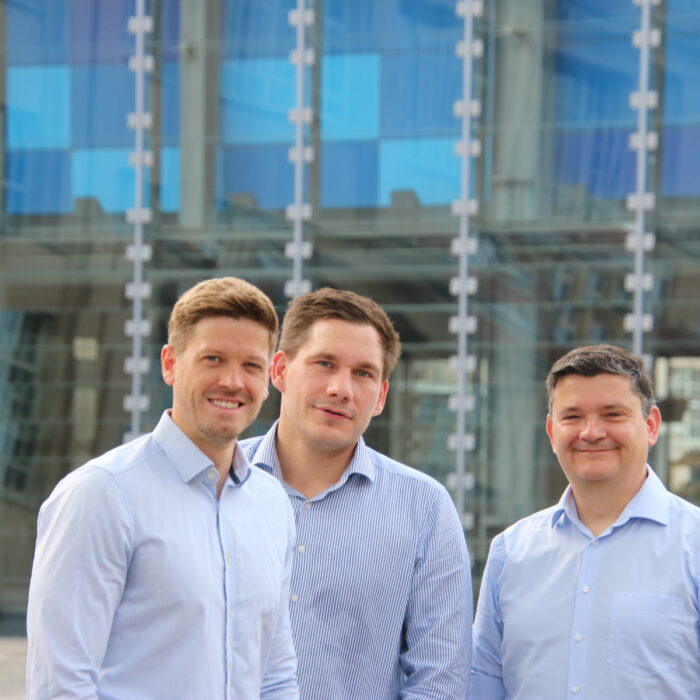
Many companies invest in data strategies – and still fail because of their own documents. diafania, founded by Vera Meinert, Michael Brunzel, and Johannes Peschko in the environment of the Karlsruhe Institute of Technology, addresses precisely this gap. The team is developing an AI-based solution to systematically make unstructured information usable and facilitate the practical use of data in everyday business life.
diafania stands for transparency, efficiency, and value creation from unstructured data. The startup addresses a widespread problem: every day, valuable information remains hidden in documents within companies. This document chaos costs time and money and prevents efficient processes and informed decisions. diafania makes this information usable. The AI platform structures documents, categorizes and prioritizes content, extracts relevant information, and integrates it directly into operational processes or analyses. This turns scattered documents into a curated, reliable knowledge base – and data into real added value.
In conversation with host Daniela, founders Vera and Michael explain why a strong technological background is a decisive advantage, especially in the AI industry, and how it feels to leave a well-paid full-time job behind and start a business based on belief in an idea. They also discuss why, from the founders’ perspective, AI should primarily serve to reduce workloads and how diafania can become a company with international aspirations in the long term. You can find the entire interview on Spotify and Apple Podcasts.

Where and how did you come up with the idea to start the company?
To be honest, the idea came about through a systematic process. Together, we collected topics that were worth working on and that were closely related to the founding team’s experiences. The specific topic then came from a joint observation from Michael and Vera’s work on AI and data projects: data availability and data quality are often the biggest challenges and prevent the full potential of data from being exploited. New achievements in the field of AI have made it technically possible and easier to extract unstructured data from documents.
The industry, target group, and industry segment were then systematically identified in two rounds of interviews, and the first prototypes were built. Step by step, individual experiences, intensive discussions, and complementary strengths gave rise to the founding idea – with the goal of not only thinking about innovation, but also making it effective in everyday work. By the end of 2024, the final vision was born: to build an AI platform for the collection and processing of unstructured data in the real estate industry.
How did the founding team come together?
Michael and Vera have known each other for quite some time from working together in the field of AI. When Vera met Johannes in 2022, he asked her, “So, when are you going to start your own business?” At the time, Vera could only laugh a little confusedly, but Johannes had recognized her creativity, determination, and drive for transformation early on. When Vera reached the point of changing jobs in 2024, they resumed their discussions about entrepreneurship. It quickly became clear to Vera that starting a business in the AI field would be out of the question without Michael’s experience with generative AI and its application in a real business environment. Joint discussions quickly revealed that the three of us wanted to embark on the path to founding a company.
What is your grand vision?
Our grand vision is to become the leading provider of AI-supported solutions for data structuring in the real estate industry and to make our technology accessible to other industries in the future. At the same time, we are aware that markets and conditions are volatile. That is why we are growing deliberately and with a sense of proportion – step by step, agilely, and adaptably. Our goal is to maintain the quality of our solution and our proximity to our customers at every stage of growth and to deliver the best possible performance at all times.

Where do you see significant hurdles in the start-up process?
We see significant hurdles in the start-up process primarily at the structural and personal level. On the one hand, socio-economic factors play a role: the courage to start a business depends heavily on socialization, environment, and the ability to endure financial uncertainty over a longer period of time – conditions that are not equally available to everyone. On the other hand, bureaucracy in Germany poses a noticeable challenge. Regulatory requirements and administrative processes are often time-consuming and slow things down unnecessarily, especially in the early stages. At the same time, we view the startup scene as very positive overall: once you have gained access, the ecosystem is open, supportive, and characterized by mutual helpfulness. This exchange and cohesion are a great strength and an important counterbalance to the hurdles mentioned above.
Where did you get support?
We mainly sought support through strong networks and support programs. These include the KIT Gründerschmiede, EXIST, the UnternehmerTUM network, and the GROUNDBREAKERS program. In addition, we participated in various competitions that gave us valuable visibility, feedback, and opened new doors in the ecosystem. We also work closely with mentors (e.g., Prof. Satzger from KSRI) and industry experts who support us strategically and operationally with their experience.
What were the biggest challenges during your start-up phase?
Life in a startup is highly dynamic: there’s always something urgent to do, there are endless projects, and you could work 24/7. The real art is to set clear boundaries and consciously take time off despite the constant stress. For us, that sometimes means closing our laptops, heading out to the mountains, and clearing our heads. It’s not always easy, but it’s absolutely necessary to remain productive and creative in the long term.
Has anything changed for you since the formal founding?
Since our founding, our approach to uncertainty has changed significantly. Although we had a realistic picture of starting a business thanks to our environment, it quickly became clear that uncertainty is a constant companion – whether in financial matters, strategic decisions, or exchanges with potential customers and partners. Especially in the early stages, many decisions were associated with unanswered questions: Are we meeting with the right people? Is the idea viable? How reliable is the feedback from the market? Over time, we have learned to accept this uncertainty and make decisions based on the best available knowledge.
Today, we are much more experienced in taking responsibility, even without complete certainty. The ability to deal with ambiguity, set priorities, and learn from experience is one of the biggest changes and developments since the company was founded.
How did you solve the problem of (follow-up) financing?
At the moment, we are mainly financing ourselves through the EXIST start-up grant and our first paying customers. At the same time, we are keeping all options open, but above all we want to remain true to our product and our vision.
Are current global crises affecting your start-up?
Global crises and geopolitical developments have no direct impact on our production or supply chains, as diafania operates as a software and AI platform. At the same time, the events of recent years – such as geopolitical tensions, trade conflicts, and the increasing focus on digital sovereignty – have significantly reinforced the relevance of our approach. We need European, sovereign AI solutions with high data security requirements.
We are currently still working with the major cloud providers, but we are constantly monitoring the market. In the future, we may have to rely more on European cloud solutions. Our software is designed in such a way that this would be possible at any time and we could respond without too many hurdles.

What are your milestones in the next 12 months?
In the coming 12 months, we want to expand our team in a targeted manner, particularly to further develop our product and scale our business model. At the same time, we will continue to expand existing customer projects and deepen our collaboration with our customers. Another key milestone is to significantly increase our reach within the industry and establish diafania as a relevant AI solution in the market.
In your opinion, what qualities should a founder have?
Founders are very different, and there is certainly no one perfect characteristic. However, it is important to be curious and willing to learn. It certainly helps to just try things out and not overthink everything that could go wrong from the outset. Which leads directly to the last point: looking optimistically toward the future is certainly also one of the basic characteristics you need to build your own company.
Do you have any practical tips for other young entrepreneurs?
Get help. It sounds obvious, but talking to others and asking for support will help you progress faster. The faster you learn, the sooner your startup can become successful. You won’t have the right solution for everything right from the start. But at some point, you’ll realize from the feedback you receive that you’re on the right track.
Looking back, what would you do differently?
It’s hard to say. Every journey is so unique. In hindsight, we would have liked to have worked on the idea together full-time earlier on. There was a gap when Vera first became self-employed. We wouldn’t do it that way again.