Founder of the month: Desoltik
11.02.2026
Emma Schmitt
Founder of the month
Electronics are full of added value – and yet all too often end up in the trash. Desoltik wants to change that. The startup is developing an AI-supported inspection solution that classifies electronics in a very short time. Repair service providers and electronics manufacturers with their own service organizations benefit from massively accelerated inspection and troubleshooting, both in repair and in the production of new electronics.
Desoltik stands for a future in which electronics are not disposed of prematurely, but remain in circulation for as long as possible. Our motivation comes from the observation that every electronic product contains enormous added value—material, energy, and expertise—and yet around 62 million tons of electronic waste are generated every year. Not because everything is broken, but because repair is often uneconomical.
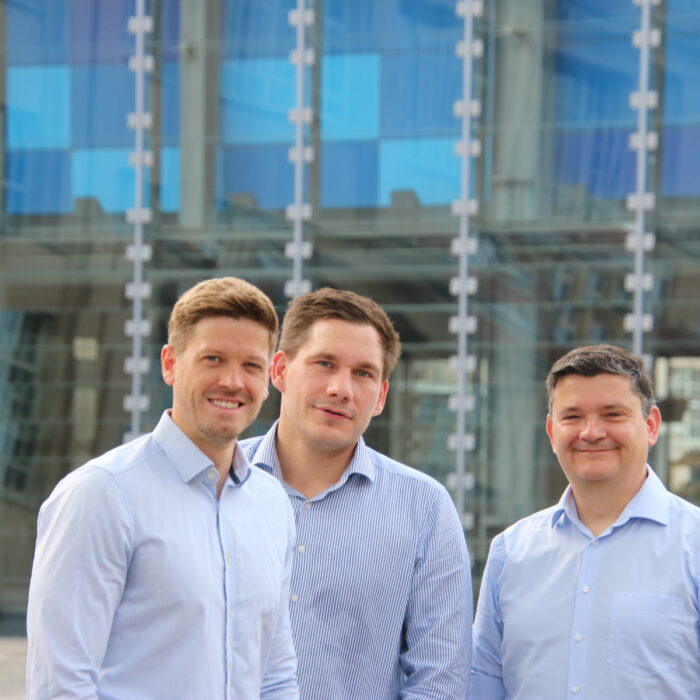
Rouven Jachemich, Maximilian Möbius, Alexander Meiners, and Florian Stamer asked themselves why this is the case and discovered that a large part of the repair costs are attributable to troubleshooting. Once you know which component is defective, replacement is usually quick and inexpensive. What is expensive are the manual, time-consuming inspection processes that come before that. This is exactly where their startup comes in.
In conversation with host Daniela, founders Rouven and Max talk about how they originally came together as a team based on a different idea and what milestones are coming up in the next year. You can find the entire interview on Spotifyand Apple Podcasts.

Where and how did you come up with the brilliant idea to start the company?
Desoltik originated in the KIT’s Student Innovation Lab, a student module in which teams are supported in founding a start-up over two semesters. That’s where we met and, through this environment, also came into contact with the wbk, which deals with sustainable production and the circular economy, among other things.
As electrical engineers, we asked ourselves whether a functioning circular economy could also exist in the electronics industry. This question became the starting point for our vision. Our master’s theses at the wbk—supervised by Florian Stamer, now our co-founder—focused precisely on this first crucial step: an economic inspection that determines what should sensibly happen to an electronic device.
Through research, initial prototypes, trade fair appearances, and market analyses, it gradually became clear that this could lead to the creation of a company. At the end of 2024 and beginning of 2025, we decided to found the company. Since the beginning of 2025, we have been working full-time on Desoltik.
How did the founding team come together?
What connects us is not only our interest in sustainable electronics, but also a similar way of working: pragmatic, curious, and solution-oriented. As the project grew, we realized that we still lacked in-depth software expertise. So we started looking for another co-founder. After several matching events organized by KIT Gründerschmiede and CyberLab—and shortly before we were about to officially advertise the position—we happened to strike up a conversation with Alex in the cafeteria. He was looking for a team, and we were looking for someone with exactly his profile. Initial conversations and familiarization led to trust and ultimately to a collaboration that resulted in our current team.
What is your grand vision?
Our vision is to use our technology to enable a profitable circular economy in the electronics industry. Decisions about repair, reuse, or replacement should be made based on data, economic considerations, and sustainability—not uncertainty or time pressure.
At the same time, we believe in a greener future in which technology and sustainability go hand in hand. We are convinced that we can solve the challenges of our time not through sacrifice, but through innovation and new technologies. Our goal is to make electronics more sustainable – and in doing so, create economic value for our customers.
Where do you see significant challenges in the start-up process?
For us, start-up means one thing above all else: simultaneity. Product development, customer projects, financing, organization, and team building all run in parallel—that’s a real challenge. We first had to learn to deal with this dynamic and consciously set priorities, which is much easier for us today.
At the same time, we realized that a culture of error tolerance is a decisive factor – especially in Germany, where failure often has negative connotations. We are convinced that innovation can only flourish where people are allowed to learn from their mistakes. The protected environment at the university enabled us to do just that: to try, to fail, to reflect, and to improve. We want to carry this attitude into our company.
Where did you get support?
Even during the Student Innovation Lab, we received early support from the KIT Start-up Incubator and the CyberForum – whether it was with everyday start-up issues, initial events, or valuable contacts in their networks. The wbk, which has accompanied us from the very beginning, was also particularly important for us. There, we were able to use existing resources and facilities and gradually transform our scientific topic into a start-up.

Has anything changed for you since the formal establishment? If so, what?
We are currently in the process of establishing our limited liability company (GmbH) and have noticed that many legal departments on the customer side are specifically geared towards this legal form. In practice, it is often difficult to implement pilot projects in a civil law partnership (GbR) structure because it offers less legal certainty. A GmbH creates a more reliable framework, signals seriousness, and makes it much easier to work with our partners and customers.
How did you solve the problem of financing?
So far, we have largely bootstrapped and are currently financed for one year through the EXIST program. At the same time, we are planning the first pilot projects for our MVP. Our focus is on achieving a clear product-market fit.
What are your next big milestones in the coming 12 months?
We have several milestones coming up in the next twelve months: founding the GmbH, further developing our product during the EXIST period, launching pilot projects with our first customers, opening up new market segments, and hiring our first employees.
In your opinion, what qualities should a founder have?
Especially in the beginning, it helps enormously to be an all-rounder and to be passionate about your own idea.
Do you have any practical tips for other young entrepreneurs?
Our most important practical tip: Talk to potential customers as early as possible—ideally before you start actual product development. Real conversations replace many assumptions.