Founder of the month: data revolution
26.05.2026
Aline Kinzie
Founder of the month
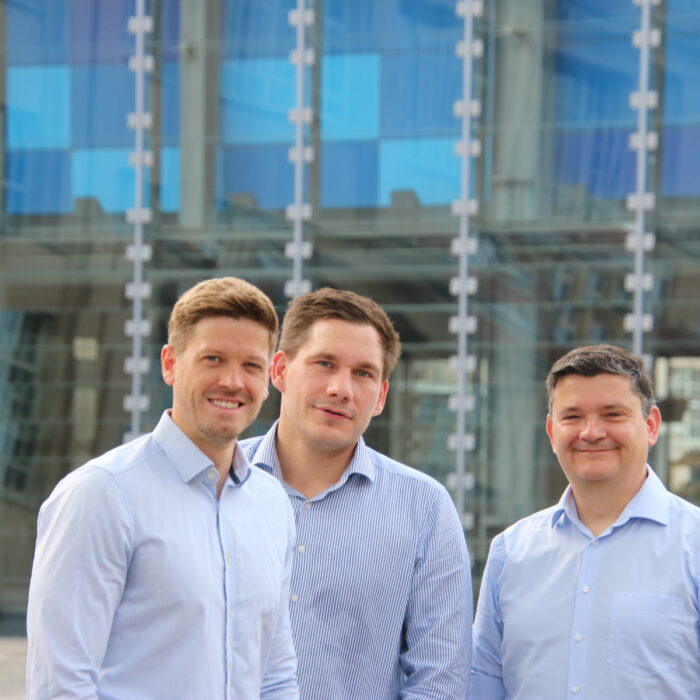
Smart devices generate huge amounts of data every day – yet it is often the manufacturers who benefit most from this, rather than the users themselves. This is precisely where data revolution comes in. The startup, founded by Philip Schütz, Dennis Häring, Johannes Birkenmaier and Sarin Ravishanker from the Karlsruhe Institute of Technology, develops solutions relating to the EU Data Act and the use of IoT data. The team’s aim is to help companies make meaningful use of data from connected devices whilst gaining greater control over their own data.
data revolution explores how companies can not only collect their data but also put it to practical use. The focus is on IoT data and the new opportunities presented by the EU Data Act. The start-up develops solutions that make data from machines and connected devices accessible and usable – for example, in agriculture or industry.
In conversation with our host Daniela, founder Philip Schütz explains how a startup emerged from a highly regulated topic of the future, why major technological changes often require patience, and why a completely new scene is currently developing around data usage. He also discusses why companies will want to have greater control over their own data in future – and what opportunities this could bring. You can find the full interview on Spotify and Apple Podcasts.

What does your company stand for?
True to our slogan “we make your data work for you”, the IT start-up data revolution has set itself the ambitious goal of becoming the central platform for empowering IoT device users (particularly in the B2B sector) to derive a wide range of added value from their IoT data. The central linchpin here is the EU Data Act, which has been fully in force across Europe since 12 September 2025 and completely overturns the ownership structure of data generated through the use of connected products and services. Whereas previously the manufacturers of connected products (which may include laptops, smartphones, wearables, but also smart home appliances, connected vehicles, Industry 4.0 applications or connected technologies in the energy and healthcare sectors) had exclusive access rights to this data, it is now the owners, possessors and lessees of these devices who become the owners of the data generated during use. Our platform is deliberately designed to be open to any form of IoT technology, but we are currently launching our market entry with a focus on cooperation partners in the vehicle fleet and agritech sectors.
How did you come up with the initial idea to set up the company?
Thanks to a book chapter on the European Union’s new digital legislation – which was started years ago and recently published – Philip engaged with the EU Data Act relatively early on and in depth. This legal paradigm shift creates – as explicitly intended by the EU – new, extremely exciting, data-driven business models. So why not launch a start-up in this hitherto completely underestimated sector (apart from a few lawyers, hardly anyone has yet recognised the huge business potential behind it)? No sooner said than done: data revolution UG was founded in January 2025.
How did the founding team come together?
Originally, Philip founded data revolution on his own and was looking for co-founders. The huge, well-organised and well-connected start-up community in Karlsruhe and Baden-Württemberg was a massive help in this regard. Events such as the TeamUp events organised by CyberForum or the matchmaking sessions run by DeepTechHub consistently attracted new candidates interested in the role of co-founder. This is also how the connection with Dennis and Sarin came about, whilst Johannes successfully applied for the role of CTO.
What is your big vision?
All users of connected products and services should be able to easily derive the added value they desire from the data generated by their IoT devices. We want to radically simplify this process and revolutionize the way this data is utilized.

Where do you see any significant hurdles in the startup process?
The actual start-up process was fairly uneventful and involved less red tape than we’d initially feared. It may have helped, however, that Philip has a background in law and isn’t exactly put off by legal issues or bureaucratic processes.
Where did you seek support?
Even before the actual start-up, we established contact with CyberForum and the KIT Start-up Incubator. We also received informal advice from coaches at the CyberLab and the Centre for Entrepreneurship at Mannheim University of Applied Sciences (MARS). After the start-up, we took part in the third Badge 2025 programme run by the CyberLab’s accelerator.
What were the biggest challenges during your startup phase?
Embracing the legal innovation of the EU Data Act as a scalable IT business idea currently means operating as an absolute first mover. Among other things, this creates the challenge of repeatedly hitting limits in discussions with potential customers, IoT device manufacturers or the public authorities tasked with ensuring the Data Act is enforced. For example, the Data Act is often lumped together with the General Data Protection Regulation or the AI Act, yet for most market players it offers not regulatory but enabling elements (such as new data access rights or simplified cloud-switching processes). A tremendous amount of educational work must therefore be done before relevant market participants recognize the enormous economic potential.
Another major challenge is cold-calling potential customers and cooperation partners. Initially, we sent a relatively large number of emails to info@ addresses. Although this resulted in a few very valuable contacts, the response rate was disastrously poor. Making contact via LinkedIn or phone calls is also only partially successful. Patience is key here, because a network of prospects, cooperation partners and customers can only be built up bit by bit and operates according to the Matthew effect, meaning that the very beginning is particularly difficult.
Has anything changed for you since the formal incorporation?
As we only really got going after the formal incorporation, a meaningful comparison is difficult. In terms of establishing contacts and public image (e.g. with customers, etc.), the formal incorporation does mean that we can now try to make an impression with a company name and an emerging brand, thereby convincing potential customers and cooperation partners.
How did you solve the problem of (follow-on) funding?
At the moment, everything is still completely bootstrapped. Alongside our first client contracts, we’re also looking into funding and research programmes related to the EU Data Act and the development of IoT platforms. We’ve also already engaged with business angels and investors, as we came second out of 20 start-ups at an investor speed-dating event organized by the City of Mannheim (Next Mannheim).
Are current global crises having an impact on your startup?
As we operate primarily in the B2B sector, we can see that the current global crises are already playing a certain role, for example when it comes to the financial leeway needed to decide whether to try something new with a start-up. During the crisis, many companies are also returning to the core of their original business model. When it comes to digitalization and data usage (perhaps even extending further into data marketing), this means that innovative ideas outside the core business model are initially ignored or given lower priority.

What are your next major milestones over the next 12 months?
We are aiming for a significant increase in the number of our partners and customers in the vehicle fleet and AgriTech sectors. Technically, our platform is already capable of processing vehicle and agricultural machinery data continuously and in real time. We would like to expand our portfolio to include further profitable use cases in the fields of mobility, energy and health.
In your view, what qualities should a founder possess?
As mentioned in the film “The Founder” (2016) – a very worthwhile film – one of the perhaps most important character traits of a successful founder is persistence, though paired with an agile and flexible mindset. Curiosity is certainly no bad thing either, and you should possess or develop a certain degree of balance and stability to be able to cope with the constant ups and downs.
Do you have any practical tips for other young entrepreneurs?
The most important tip: Just do it! Just get started. Things always turn out differently than you expect anyway. And you learn as you go. Share your ideas with as many people as possible and put aside any worries that your product idea might be copied or stolen.
Looking back, what might you do differently?
Enter the market later – although then there might be no one else shaping and influencing the market around the EU Data Act quite as we are doing.